Tuesday, March 23, 2021

Reflections on Ignoring Pain


Many years ago, I was talking with my brother about a health issue that one of my sisters was having at the time. He said, 'Well, I told her that if you ignore it, it will go away', to which I responded, 'YEAH! That's what I always say!'

'No,' he said, 'I was being sarcastic. You shouldn't ignore health problems', and he gave me a look, like, 'What's wrong with you?' But for me, over the years, honestly that has been the best approach. 

In the months leading up to my first marriage, when I was working and in graduate school, juggling a long commute from my home in southern Maine to my university in Boston, a strained relationship with my fiancé and his family, and wedding planning, I was suffering from crippling abdominal pain. It hurt just to breathe, as if all my organs were swollen. I went to the university health centre, and had all kinds of tests done, but they couldn't find anything wrong with me. 'It's probably stress', they finally concluded. And sure enough, after the wedding when I had slightly less on my plate, the pain went away.

In the months after my second marriage, when I was working three jobs, unloading 90% of everything I owned, moving into a temporary room in preparation for emigrating to a new country that I knew practically nothing about, leaving behind my family, friends, career, and everything I considered 'home', I started feeling this strange, painful sensation in my throat and chest, like I swallowed a hard candy. It felt like something was stuck, and no matter what I did, it wouldn't go away. The doctor examined me and ordered an MRI, which came out normal. 'It's probably stress', she finally concluded. And sure enough, the moment I stepped off the plane in Dublin, that feeling in my throat was gone.

Other pains, such as abdominal pain that I asked doctors about for decades, was put down to normal female reproductive pain, probably from ovarian cysts coming and going. Only through trying to get pregnant did anyone decide to investigate it. I had endometriosis, as it turned out.

I struggled with shoulder pain for years before a doctor finally ordered an MRI and whoops! By then, I had a partially torn rotator cuff from a bone spur that had been growing and the only course was surgery. When I tore the other side, a different doctor, incredulous that I'd had a tear ten years previously, told me I was too young to have torn it at my current age, let alone younger. The MRI, which I pushed for, showed (quelle suprise!) a partial tear. Since it's from an injury rather than a bone spur, and it's not as painful as the other one, I just deal with it.

I've learned that I have a high threshold for pain based purely on the number of ailments I have ignored over the years. When I recently discovered that I am peri-menopausal, I realised that I had had many symptoms leading up to it, but had ignored the majority of them.

Women are taught to ignore pain of all kinds.

In my previous post, I talked about all the symptoms that I have been unable to ignore these past few months, and my journey to figuring out their cause. Happily, all of the exams, tests, and scans have come back normal. The picture of health! And that old chestnut,  'It's probably stress' looms large. However, this time, there's no stress. Home life is great. My job is great. Friends are great. Family is great. Fitness levels are great. Money stuff is...good, which honestly I'm happy with. ('Great' would be a stretch!) I've never been less stressed in my entire life. 

My head isn't haunted, like. Something is causing me to hear and feel the blood pumping in my left ear. It's not a magic spell or a ghost. There is an explanation and I won't give up until I find it. 

However, I have had to go back to the drawing board. And that has led me to realise a sort of elephant in the room: I have been ignoring pain in my neck, back, ribs and hips to such an extent that I didn't even really acknowledge its existence until now. After ruling out everything else, suddenly there it was: I'm in pain! Pain that could be impacting the rest of my body. Pain that probably could be relieved. So I made an appointment with an osteopath.

The laundry list of ailments that I gave this poor guy - how was I walking around with all of that going on? From head to toe, I described no less than ten points of chronic pain that have been going on for months to decades. When he examined my neck, he described the left side as 'totally jammed'. As he turned my head, the rest of my body followed. I felt embarrassed for myself - I don't even remember the last time I turned my head without a cacophony of crunching and strain.

Is my 'jammed' neck causing all my problems? Probably not. But will I feel immense relief once it's unjammed? Once I start rehabbing my displaced ribs? Once I fix the pinched nerve in my leg? Once I stretch out the achilles tendon pain? Once I attend to this tennis elbow, and so on? I surely will. 

This is all a long-winded way of saying that despite all my work trying to be healthy and get a diagnosis for health problems, I still managed to shove down and neglect my body. So I recommend doing a scan of yourself and trying to be honest, like really honest, about how you feel? Do you have pain that you're ignoring?  

Wednesday, March 3, 2021

A picture

Previously, I posted about how I've been doing things to improve my health since lockdown. Once I recovered from an infection last March, I re-started the couch to 5k and slowly built up to 5k and beyond. I can now run a 10k easily and plan on increasing my run times once the weather warms up a bit with the goal of regular 15 to 20k runs. 

I also have been incorporating other types of workouts depending on my mood, which may include weight or strength training, yoga, ballet, dance workouts, aerobics. And I walk pretty much every day in addition to all of the above. 

Expanding my cooking horizons has become a real highlight of lockdown life, and my diet is healthier than it's ever been before, filled with tonnes of vegetables and fruits, healthy vegetarian proteins, and very little fried foods. 

My alcohol and caffeine intake is moderate. I have one cup of coffee each morning (occasionally two on Fridays and Saturdays) and I like to have a drink, sometimes two, of an evening (but not every evening).

Recently, I bumped into a friend of mine while on a run and he described me as 'the picture of health' and I had to agree. I feel really good - strong, energetic most days, and all of the exercise has improved my mental health considerably. But a picture can hide as much as it conveys. It reminds me of when my dad used to respond to compliments on his youthful appearance with, 'I'm rotting from the inside out'.

I've been battling a frustrating medical condition that is not only rare, but invisible. And it's not the first time. 

Back in late 2017, after a trip to Venice, I came down with a bizarre vestibular issue that made me feel like I was on a boat. All. of. the. time. For several months, I walked around with sea legs and felt myself floating on a non-existent ocean as I tried to fall asleep. I even suffered with sea sickness from it. Finally, I was able to gradually rid myself of the affliction through vestibular physical therapy. Then, a year after my remission, it came back and lasted nearly another year. While I still have balance issues caused by damage to my right inner ear, I'm off my boat and can mostly ignore it in day-to-day life.

So, when I started having pain and fullness in my ears last year after a bad cold, I figured it would go away. When it didn't, I went to the GP who gave me antibiotics for a middle ear infection. The pain eased, but I was left hearing the sound and sensation of my heart beating in the left side of my head. It's called Pulsatile Tinnitus and it's constant. The only time I don't hear it is when other noises drown it out. But I began to notice other things, like tingling on my head, mostly on the left side. Fullness, neck pain, eye spasms, headaches are others, and for the past month I've been trying to ignore other worrisome symptoms such as dysphagia (trouble swallowing) and an ache in my left leg.

Since last summer, I've had two ENT consultations, an MRI, and MRA, a dental checkup, several craniosacral therapy sessions, a full blood workup, and I've tried taking a month off my ADHD medication. None of those things produced answers or a cure. I joined a Facebook group for people with Pulsatile Tinnitus and began educating myself on the most common causes. 

Pulsatile Tinnitus (PT) isn't a diagnosis; it's a symptom of something else, and it's usually nothing to do with the ear, though many make that assumption. As I started reading people's PT stories, I saw how difficult it is to get a diagnosis. Most of the people in the group have spent years getting to the bottom of it. But an alarming number, when they finally discover their diagnosis, have life-threatening or serious conditions, usually vascular in nature. There was even an episode of House about it!

My symptoms are most noticeable first thing in the morning (from the quiet and the pressure of my head on the pillow) and late at night (also from the quiet). This can make sleeping difficult, not just because of the whooshing noise in my ear, but also because I often find myself unable to sleep, stuck in an ADHD hyperfocus, looking online for answers to what's wrong with me. The panic caused by googling symptoms is something we've all experienced. After months of dealing with a mystery condition, you can go a little mad. And then, add to that the condition itself, a constant whooshing in my head of the blood flowing through my body, and it's a wonder I can function normally.

I made it my mission to find someone in Ireland who wouldn't fob me off as my GP and ENT had. I started to research the types of specialists who diagnose the most common causes of PT. Finally, I found a news article about a consultant in Dublin who I thought may be able to help me, and I emailed him to see if he had dealt with PT. My heart leapt when he responded that he had. He told me the main conditions that he would want to rule out, and when I saw that they were all vascular, I made an appointment to see him in person. We discussed my symptoms and previous scans. He looked in my ears with a special microscope just to be sure I didn't have a specific ear issue that can cause PT. He said that he wanted to send me for a CT angiogram to check my arteries and to rule out fibromuscular dysplasia (FMD). I had come across FMD in the Facebook group but I didn't remember what it was. He wrote it down and told me to look it up when I got home. I left feeling comfort in the knowledge that I'd found someone who may be able to help me. I felt hope for the first time in a long time. 

I didn't bother to google FMD for more than a week. When I did, I have to say, I wasn't thrilled, especially when I reviewed the list symptoms, most of which I have. I keep telling myself that just because I have most of the symptoms, doesn't mean I have it! But then I think, if it's not this, then what is it? All I know is, I've accepted that this isn't going away, it cannot be ignored, and I will not stop until I know what's going on. 

Tomorrow, I'll be going for the CT angiogram. I didn't google that either until I was discussing it with my manager at work and he googled it. That's when we both realised how naive I'd been only taking the morning off work. It's definitely a full day off from work procedure. 

Why am I writing all of this? A couple of reasons. First, because I want to say to anyone searching for a diagnosis to any sort of medical issue, DO NOT GIVE UP. And secondly, because while I'm doing really, really great in so many ways -- better than I've ever been in my entire life, in fact -- I'm still having a hard time with this one aspect of my life and I'm suffering physically and mentally. I'm afraid of what lurks behind this picture of health. I'm afraid that I'm not actually healthy. I'm afraid that I'll drop dead before I figure out what's wrong with me. I'm afraid that I will have to give up this new active lifestyle that is part of who I am now. I'm afraid that I deserve this. I'm afraid that I'll never know, like so many people with PT and other conditions. 

But at the same time, I feel incredibly OPTIMISTIC. I swear, I do have a balanced view. I'm taking it in stride as well as anyone could. I'm confident in my new doctor. I'm confident that I can do whatever needs to be done to cure myself once I find it out. I'm grateful that I have amazingly supportive friends and family to help me in all kinds of ways. And now, we'll just have to wait and see. Wish me luck!

xoxo

Skincare tips from a lady in her late 40s who has tried everything

 I need to acknowledge how incredibly lucky I am in the skin department, for the most part. However, age makes everyone its bitch and despite being a stone's throw from menopause, I still get spots. And to make matters worse, my skin has always been dry as a biscuit and allergic to practically everything, including citrus oils (bergamot, limonene, linalool, etc., which are in the majority of skincare products).

Thanks to my mother's extreme paranoia of looking her age (which, it must be said, served her well), I have tried to care for my skin from a young age. When I was 7 or 8, I remember spending my allowance on clay masks and moisturisers! (I should have been buying sunblock, but it was the 1970s so that wouldn't happen until, oh, twenty years later.)

When it comes to beauty and skincare in particular, a lot of people I know take one of two approaches: natural products only and 'throw every chemical known to man on there'. I fall somewhere in the middle. It's also very easy to spend a LOT of money on skincare, but these days there are loads of affordable products that easily compete with the pricey stuff.

Recently, I have been using the 'curly girl method' on my hair, which entails cutting out silicone in my hair products along with drying alcohols and detergents. And that got me thinking, if silicone and that other nasty stuff dries out my hair, what are they doing to my face? I  read the labels of my skin products, and discovered that most of them used silicone, even the dermatologist-recommended brands, such as Cetaphil, Cerave, and Elave. It turns out that silicone is actually not bad for your skin -- it can help retain moisture -- but I also don't want it in every single product, so I started searching for silicone-free skincare products. It was especially difficult to find moisturisers with SPF that didn't use silicone. But I found some, and I'm going to tell you how!

There are two websites that I use to figure out if a hair product is 'curly girl approved: IsitCG and CurlsBot. You simply copy and paste the ingredients into the tool and it tells you which ingredients are not 'approved' and which ones you should use with caution, such as ingredients that can leave build-up residue over time. Having realised that all of the precautions I take with my hair are the same ones I wanted to take with my skin, I decided to use the tool on skin products. 

One of my favourite brands at the moment is an American brand called Acure Organics, which is very affordable and can be ordered online, but it's not always handy to do that from overseas. If you're in America, though, do give it a try.

Cleansing

Ironically, I have found that the best routine for my skin has been a 'less is more' approach. For example, if I don't have makeup on my face, I don't wash it at the end of the day. And if I'm showering first thing in the morning with a bare face, I usually won't cleanse it in the morning either. I only cleanse my face after exercise and to remove makeup. Otherwise, I leave it be.

You may have heard of people who use oil cleansers, either formulas made by a company or an oil you can buy in a food shop. Coconut oil is one you see online a lot. While coconut oil is great for removing eye makeup, I do NOT recommend coconut oil to cleanse because it is highly comedogenic, which is a fancy way of saying it will clog your pores. If you like the idea of cleansing your face with oil, I recommend hemp oil, which available in any health food shop. Simply spread it over your face, and then wipe it off with a hot, damp cloth. Personally, I no longer cleanse with oil because the hot water in my house (and most houses in Ireland) is unreliable and you really do need hot water to rinse the oil from the cloth after you've removed in from your face. And even then, the oil tends to discolour the cloths over time. 

I recommend gentle, silicone-free creme cleansers. Here are a few that pass the test: Acure Seriously Soothing Cleansing Cream (UK link here), Earth Science, A-D-E Creamy Fruit Oil Cleanser, Dry & Sensitive SkinDr. Organic Argan Oil Face Wash, Dr. Organic Manuka Honey Face Wash, and Sukin Cream Cleanser

Moisturising

My skin has been dry since I was a baby, so I am always battling cracks, flakes, and rough patches. Here are the night-time moisturisers in my rotation currently: Sukin Calming Night Cream, Sensitive, Acure Radically Rejuvenating Whipped Night Cream, Acure Ultra Hydrating 12 Hour Facial Moisturizer.


And for day time, I try to use moisturisers with a fairly high spf, though it's difficult to find ones that I'm not allergic to, even the supposedly sensitive ones. But these three have worked well:


Serums and other anti-aging measures

Once a week, I try to exfoliate with this glycolic acid cleanser from Image. Don't use
those abrasive exfoliants on your face! Back in the day, we used that apricot scrub,
which felt amazing, but as you get older, your skin is much more delicate and it can
wreak havoc. So you're better off using a chemical exfoliant. I massage it into my
face dry for exactly one minute, then rinse off with a cloth. 
In addition to my moisturiser, I alternate a few serums, which I use depending on what my skin is doing, the weather, and my plans for the day.

Because I have dry skin, I often use hyaluronic acid serum right after I wash my face. You want to always use hyaluronic acid when your skin is freshly hydrated (in other words, after it's just been wet). If you want to use it but haven't just come out of the shower, you can splash or spray your face with water, dab it dry, and slap some on. I use The Ordinary Hyaluronic Acid + B5 because it's cheap and cheerful. 

I'm prone to hormone-related breakouts along my jawline and hairline, so I like to use a couple of products that keep these at bay and clear things up if I happen to get a couple of spots. They're both from The Ordinary: Niacinamide & Zinc Serum and Azaleic Acid Suspension. (The latter does contain silicone and has been harder to find in Dublin.)
Lately, I've been trying to give my under-eyes some love and attention, so I've been using these two products: The Ordinary Caffeine Solution and CeraVe Reparative Eye Cream
And finally, a few nights a week, I like to use a couple of oils. To combat wrinkles, I use The Ordinary Retinol Serum and then I like to use a roll-on rose hip oil around my mouth and eyes just to keep things soft and supple.
Before I close, I want to add one last product, which is somewhere between skincare and makeup. Glossier's Futuredew is an oil serum hybrid that gives my skin an amazing glow on days when I just want to look more polished. It's very subtle and I love the way it looks.
What are your favourite skincare products? Is there something you think I should try? Tell me about it!


Tuesday, September 22, 2020

Bedroom refresh: the big reveal!

 Back in February, anticipating having to spend a lot more time in my bedroom, I posted plans for a little bedroom spruce-up. And for the past seven months or so, I've been slowly working away at it. The pandemic put a bit of a monkey wrench in my plans at the start, since IKEA was closed and they weren't delivering large items. And then building the cabinets, attaching the legs, securing everything to the wall, painting, organising the insides, and sealing the finish was a pretty long process. All worth it, I think! 

First, the desk area:

Before
After


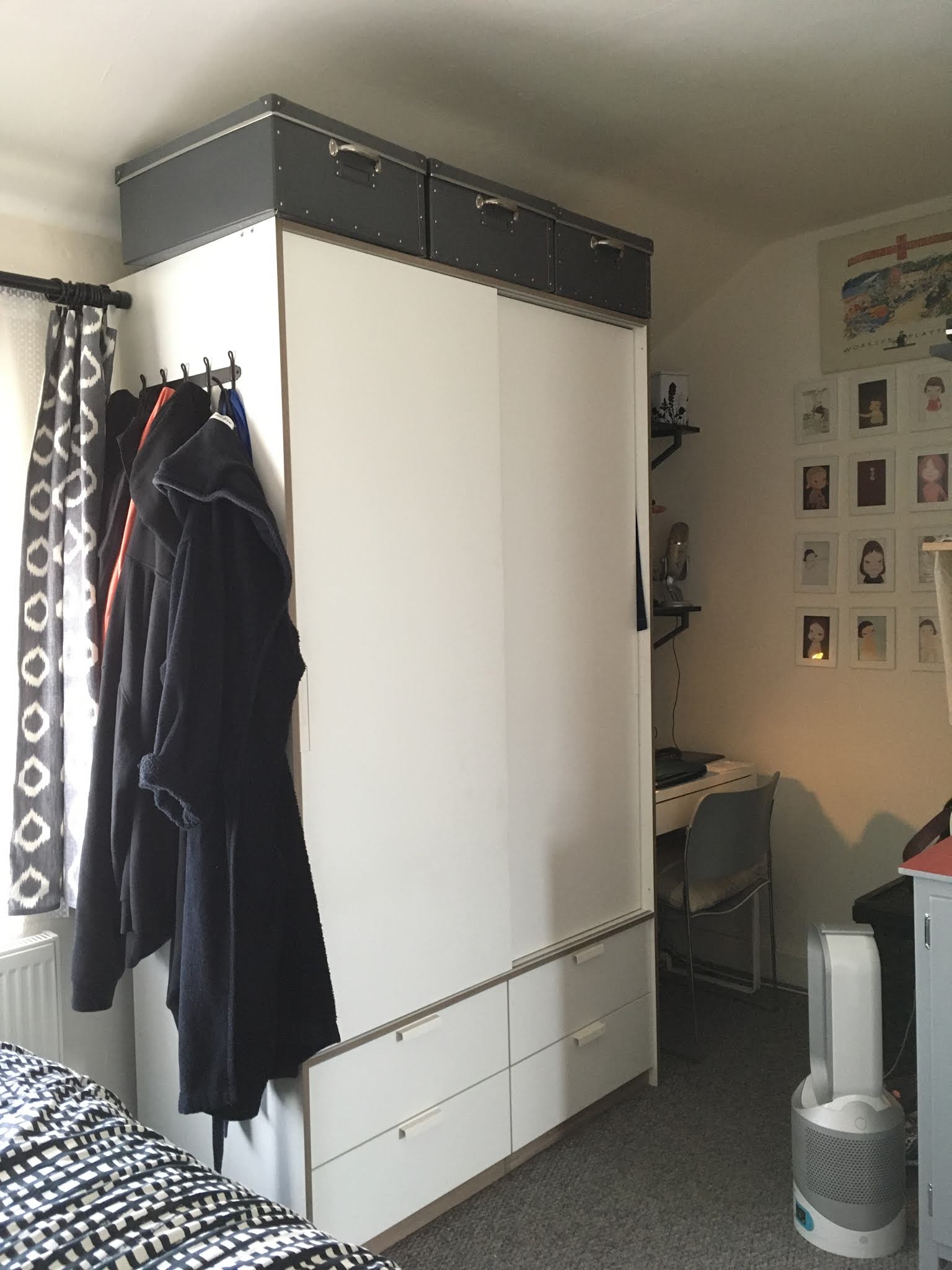
I finally managed to get into an IKEA and buy the IVAR cabinets I needed. I bought legs online. Here's how it looks with the doors closed:
     
Before
 
After


Inside, I created a vanity area on the left and shoe storage on the right. I placed the extension lead where the TV, DVD player, Dyson, and vanity light plug in underneath so I could access all the plugs. I left one for my hairdryer, which is stored in that picnic basket up above :)
     
Vanity
 
Hidden Shoe Storage


I did a slight whitewash treatment to the upper cabinets to get rid of the yellow tone of the pine wood and added copper knobs. As you can see, I painted the lower half of the wall to match the cabinets, and extended it around the corner and painted the laundry basket and stool to match (sadly, I couldn't paint the Dyson air purifier, or else I would have!).

I decided to give the bland white wardrobe a bit of an update, and covered it in wallpaper to coordinate with the walls and cabinets. I used double stick tape layered over masking tape, so everything is completely reversible if I ever get sick of it. 

And finally, the bed area got a makeover, though I did change my plans and decided that a shiplap wall would be expensive and time consuming, not to mention a two-man job. First, I bought myself a new headboard, which made a huge difference straight away. I painted behind the headboard a terracotta colour and then decided to top it with a little archway for the drawing up above. I thought I might run a little shelf across, but I might just keep it simple and leave it like this. 

The old black Billy bookcases got covered in wallpaper to brighten them up a bit, and the base of the bed got covered in faux grasscloth peel and stick wallpaper. Voila!

     
Before
After


Of course, there are still some details left, such as a new rug and a makeover for the other wardrobe. Overall, I'm very pleased with how it came out, and I was able to do some reorganising and clearing out at the same time, so this can truly be a peaceful space to spend my days...and nights!


Friday, July 24, 2020

How I lost weight (content warning: this post is about weight loss)

I wrote a blog post a few weeks ago about how I was attempting to lose weight. Now, I am a mere 300 grams shy of having lost 10 kilograms (i.e. 22 pounds or 1.5 stone) since the beginning of May (just over 11 weeks), which is a reasonable amount of time. In the past, I've tried all kinds of diets and programmes for both health and weight loss, including the Whole 30 diet, Weight Watchers, and plain old calorie counting. About seven years ago, I lost a stone on Weight Watchers, but I remember it being really hard and I was constantly referring to booklets and charts to find points, not to mention that my memory of it is just a constant feeling of being hungry.

Other times when I tried simple calorie counting, I just didn't lose weight and stopped trying. I heard that Weight Watchers had yet another new system and was interested, but then the pandemic happened and it's actually rather difficult to figure out how to do the online WW. That's when I decided to try something new.

I bought my first Fitbit five years ago because my siblings all had one and were competing for steps against one another, and I wanted in on the fun. Once I kicked all their butts, I stopped for a while, then started back up again, but lost the dang thing so I bought a new one in the same price range (the Inspire HR, about 100 euro) and was surprised to find that the new one did a lot more stuff than the old one!

Since I was already doing a lot of exercise, I knew that I would need to change my eating habits if I wanted to lose weight, or to be more precise, be smaller. But honestly I just didn't want to have to do a lot of mental work or futzing around. I decided to give into the marketing ads and try Fitbit Premium, especially since there was a free three-month trial.

I set a weight goal for myself, and then I told the Fitbit app how hard I wanted the weight loss process to be; the harder it is, the more weight you lose. The choices (with calorie deficits in parenthesis) were Easier (-250), Medium (-500), Kinda hard (-750), and Harder (-1,000). I went with 'Kinda hard' because I am only five feet, one inch tall and I think a 1,000 calorie daily deficit would be detrimental to my health, physical and mental.

Here's where it gets interesting. Obviously, you wear the Fitbit all day and it monitors your steps and heart rate. Based on your information, it calculates how many calories you are burning throughout the day. When you eat, you enter it into the app. Most foods are in their database, but you can add custom foods. The app constantly updates and tells you how many calories you have left to stay within your daily allotment, so you don't have to do any maths or think about it too much -- you just enter in what you ate. On more active days, you can eat more; if you are less active, you can eat less.

I can eat whatever I want as long as I have burned the calories. And I know this sounds like one of those weight loss ads, but for me it's really important. If I want to eat more, I just have to exercise more, and that can take many forms. For me, it's usually running, walking, or cycling. You'd be surprised how many calories you can burn in a short amount of time. I've literally wanted to eat something, looked at my Fitbit, and then walked around the block so I could have it.

Having said that, there are some foods that have really gotten me through, which I'll share with you:
1. Slimbos or Slimbos-style buns. They are about 100 calories and I have one every morning for breakfast. They're also great in place of regular burger buns.

2. Eating a protein-heavy breakfast. I generally have two eggs and a Slimbo for breakfast at 8:30am every day and then I don't eat again until 2:00 or 3:00 in the afternoon. As a person with dodgy blood sugar issues, those two eggs keep me from getting the shakes later on.

3. Feeding cravings with vegetables or fruit first, then deciding whether I really need the thing I'm craving. If I'm feeling like I need something, I might slice up a courgette and sautee it in some spray oil and garlic or eat a sliced tomato with pepper and salt, then evaluate whether I still need the thing my brain told me I wanted. Usually the answer is no. Basically, 80% of my diet consists of vegetables now.

4. Some fruits are surprisingly low in calories compared to others. I've been eating a lot of mangos, but some melons are crazy low in calories. I've never been a huge chocolate fan, so for me, if I'm craving something sweet, something fruity will usually do me. But having to enter in calories for my food has made me aware that, for example, 100g of fresh pineapple is about 100 calories, 100g of fresh mango is only 60, but 100g of gaia melon is only 25. If I'm cutting it tight at the end of the day and it's there, I'll go for the melon.

5. A little of something is usually enough. Before, I'd just eat past the point of full, regardless of what it was. Now, I've realised that a mini ice cream gets me over the craving hump as well as a full-sized one.

6. Alcohol not only makes me hungry, but as my inhibitions fall, so does my willpower. Over the past three months, nearly every day I've gone over my calorie budget involved alcohol, and not just the alcohol itself, but the fact that after a couple of drinks I want to eat everything in sight. Just something I have been trying to overcome and have no solution for, but consider yourself warned.

7. Speaking of alcohol, some are more caloric than others. I love the new hard seltzers that you can get now because they're only about 100 calories per can. But equally, I have found that I'm just as happy with gin and seltzer with lemon or lime and it's a lot cheaper. Being mindful of my calories has made me more mindful of my drinking, which, to be honest, I needed. Turns out, it doesn't solve life's problems and when I drink less, I enjoy it more when I do.

8. Shirataki noodles have been a great discovery! They are glassy noodles that you can get in the asian food shop and they are ridiculously low in calories. You can nearly bulk buy them because they keep for a long time, which is nice.

9. I used to be a 'full fat or gtfo' kind of person. But yes, now I eat low fat cheese slices and low fat Greek yogurt. It's not always a big difference, but sometimes it really is. Once I'm at my goal weight and not working with a 750 calorie deficit every day, I'll probably go back to full fat. Or maybe I won't.

And that's the thing. I've been amazed at how used to all of this I've become. Eating less food means I don't need to eat as much food. Often, I don't even use up my calories because at a certain point I can now ask myself WHY I want the thing and I know that if I just hold off, I will likely forget about it and then my brain moves on to something else. Or I just don't miss things I used to have all the time. For example, I used to put a tonne of butter on my toast. Now, I use either 1/4 or 1/2 teaspoon per slice and I don't eat my toast wishing it had more butter on it. I just don't.

But the bottom line for me is the way that the Fitbit allows me to easily see my intake and output so that I can plan my food (or my exercise). And that makes me feel like I have complete control and that I can eat whatever I want if I'm organised about it.

The thing that's made the biggest difference in terms of seeing changes in my body has been adhering to a strict exercise schedule. Monday to Friday at lunchtime, I exercise. That's my time for me that I carve out (unless something unusual is going on that day). I started doing strength training sometimes at lunch and then going for a run in the evenings after work, which means I can run for longer. But unless I'm sick, I exercise, and even if I'm sick, I'll usually at least be able for a walk. It has become habit and I'm enjoying how much better at it I'm getting. Over the past three months, I have gone from week 1 of the couch to 5k to being able to run nearly 7 kilometres without stopping. I can feel myself getting stronger. My mental health has vastly improved and I'm getting more fresh air and sunshine. It sounds really cliché but I do have so much more energy and when I'm tired, it feels like a physical tiredness, not a mental one like I used to have.

I will say this, though. I'm very privileged to have been able to purchase a good quality used treadmill when we moved into our house. Living in Ireland (especially when I was under strict quarantine) means it rains a lot and going outside to exercise is often not appealing. Gyms are expensive and for me they are a big time suck, having to pack the bag and futz with toiletries and lockers. Having a treadmill in my house means I can pop a film, podcast, tv programme, etc on my phone and take a run or walk at any hour of the day.

But you don't need a treadmill or really any equipment to exercise in your home. I regularly use youtube for strength training workouts, ballet classes, yoga, and cardio workouts in my living room for free. No equipment needed!

A lot of people limit carbs or go high protein, eliminate certain foods or drinks and all of that, but I am just too lazy for that shit and I like being able to eat whatever I want. I like that  I can change the setting from 'Kinda hard' to 'Easy' any time. I like that I don't have to think about points or nutritional value or anything about the food -- just how many calories it has. And if I eat more than the app tells me I can once in a while, it is honestly not the end of the world. Before, when I overate, the guilt just piled up from the days and weeks before. Now, I don't panic and I just try to take a couple of extra walks in the following days. My total goal is two stone, and I'm 3/4 of the way there. These last few pounds are not going to melt off as easily as the first 20, but it's ok because I know that if I just do my best, I'll get there eventually.

I have no idea if this is at all helpful. I'm happy to answer any questions if there's anything anyone wants to know. 

Tuesday, May 26, 2020

Thoughts on losing weight (Content warning)

Content warning: Weight loss, body shaming, etc.

Apart from my short stature (5'1"), my physical person has always been decidedly average, which is perfectly ok with me. I was never the prettiest, the fastest, the thinnest, or the most graceful person in school. I was both a tomboy who played in the dirt, ran around fields, woods and streams, caught frogs and other unfortunate reptiles and insects, and a girlie girl who danced ballet at least three days a week for ten years. I wasn't much for contact sports, but on any spring, summer, or autumn day you might have found me playing tennis in the condo complex we lived in, or racquetball with my dad, and when I wasn't playing tennis, I was swimming my heart out in the neighborhood pool, cycling around the complex, or rollerskating. In winter, I was an avid skier. Later, I took up running, made trails in the woods with a weed-wacker and a hatchet for fun, and my friends and I tried to learn volleyball (we sucked).

My point is, I was always a physically active person growing up. But at the same time, I always thought I was fat.

When I was about five years old, my mother was helping me get dressed and she stopped, in horror. "You have cellulite on your stomach!" she said.
"What's cellulite?" I asked. She grabbed the layer of fat on my stomach, and I could see little dips in my skin.
"That!" she said, appalled. I didn't know what it meant or why I had it. But I sure knew from that moment that I should be ashamed of it. And I was, sadly. This was the late 70s -- the era of thin and slim. Like a lot of girls, I remember trying to diet when my age was still in the single digits, reading women's magazines to get the inside scoop on shedding pounds.
I was already dieting when this photo was taken.

I love my mom and I know she herself has battled the same issues, as did her mother. She lives under the foot of patriarchy that oppresses all of us. When she brought me to nutritionist appointments to talk about how I could lose weight, I wanted to go. I wanted answers. I wanted the magical formula that would make me thin. Except...

I was thin. 

The problem with an eating disorder mindset like the one my mother and the majority of women are raised on is that you are never thin enough. (Or, if you are thin enough, then the threat of regaining the weight is a constant threat, hovering over you at all times.) So for nearly five decades, I have lived with a constant, inescapable feeling that I cannot be happy with my appearance. Ever. Because there's always a few more pounds to lose. 

Finding feminism taught me other ways of thinking about women's bodies. Punk taught me about alternative aesthetics. Riot Grrrls showed me that fat can be cool as fuck. It's been a very slow and gradual process, but I see so much beauty in bodies of all types. Genuinely.

Me? When I look in the mirror, all of that insight and inspiration instantly vanishes. Above a certain size, my self-confidence shuts down. I analyze every photo. I stop thinking of myself as a sexual being. I stop thinking anything positive about myself. If someone tells me I look nice, I cringe and I definitely don't believe them. I can only think of that unattainable body I'm not living in, the 'real' me that I could be if I weren't so shit. I look at photos taken when I was thinner and hate myself even more.

Add to that, in my late forties, my aging face, the sagging areas of my body that never sagged before. The fact that my metabolism has slowed. My hair isn't as thick and shiny as it was. I have melasma around my eyes. The list is long.

This is not a unique story. Lots of women reading this will probably be thinking, "Yep. Same. What's your point?" In a recent Zoom call, I told some school friends that I'd gained 30 pounds (over 2 stone/13.6 kilos) over the past couple of years. The announcement was met with a sad, awkward, pitiful silence until I added hopefully that I was trying to lose it.

I'm trying to untangle about three issues all at once, I think, so please bear with me.

Genetically speaking, I'm not prone to thinness. Culturally speaking, I was raised on large portions and convenient junk food. While my mom was taking me to the nutritionist, our presses were stuffed with sugared cereals, mac and cheese, sugar sodas, all manner of cakes, several varieties of crisps, double stuff oreos -- you name it. So for my entire life, I've had to wrestle with an extreme push and pull, fighting the starve and purge cycle and the control/shame cycle it comes with.

At a certain point, I said fuck that. I tried to be more relaxed about food and really ditch food guilt. If I'm going to eat, I decided, I refuse to tarnish the amazing experience of eating with shame. Who wants to look back on a party where you had a great time with friends and take away from a lovely event by thinking, "I was bad for eating so much cheese, though." Then your mind pushes the dancing, the chats, the feeling of connection to the back and the food guilt obscures those memories. Instead, I taught myself to say, "I had such a good time, and the cheese was so amazing, I couldn't stop eating it." I try to replace the shame with gratitude. I mean, how lucky that I can eat loads of cheese! What a fucking great thing! Once I took that power away from food, I stopped having as much of an emotional connection to it. I felt more free.

Losing food guilt has not made me feel better about my body, however. And not being a person who turns to food for comfort doesn't mean I don't consume more calories than I burn. But I really thought it would be easier to change how I felt about my body than it would be to lose weight.

Trying to juggle a job with a long commute, full-on pro-choice activism (and some other activism on the side), renovating a house on a tight budget (ie, not being able to hire builders) and coping with the illness and deaths of my in-laws took its toll on me, starting roughly in the summer of 2016. I barely made it through each milestone, but I survived. We moved into the house. We won the referendum. Eventually, I bowed out of activism. The fallout from my in-laws' deaths became more bearable. But I still struggled to process everything that happened. So I fell into a pattern of work, dinner, couch, bed. Near daily drinking. Lots of snacks. Hiding. Not feeling motivated to change. Thinking about everything I should have done differently. Wishing my life were different. Wishing I was different.

But if we want things to change, we have to do something differently. And eventually, I started the process of repairing myself. I got a new job working with really lovely people in a much better location and working from home three days a week (currently 5 days, of course). I started running again, in stops and starts (mostly due to illness). I started to want to reconnect with people again. I started to forgive myself for not being perfect. Gratitude started creeping back in. I started to feel gradually better, like I was emerging from a shell, even though I hadn't lost any weight.

If you think I'm going to say that I felt better about my body, you're wrong. I still looked in the mirror and shuddered. For a month, I went running five days a week and my jeans were just as tight. I weighed myself and that's when I realised that at some point in the course of four years, I'd put on over two stone.

It turns out that for me, it's easier to lose weight than accept and love my body the way it was. I hate saying that. I hate that it's true. Accepting myself at 160 pounds was an impossible burden that I could not carry. And I am well aware that 160 pounds at 5'1" is not huge.

After three weeks of using my fitbit to calculate my calorie intake/output, I've lost over half a stone (8 pounds/3.8kg). While I'm not starving myself, I am walking that fine line between having a plan and having an obsession. I find myself looking at the calorie tracker, watching to see if the available calories went up. I am never over, always under. I resist the urge to weigh myself more than once a week. I resist the urge to starve myself. Still, I resist the urge to eat cheese.

I have failed. Fat phobia won. All the programming of patriarchy and women's magazines and, you know, everything, was more powerful than my feminism, when it came to how I feel about my own body. Other people can be beautiful at any size, but not me. I'm not allowed. It would require a level of re-programming I'm not capable of when I look at myself. So here I am, trying to walk the line without falling over a precipice. I just hope that this time, I can find some point of satisfaction because my body (like everyone's) is aging and I want to experience what it's like to love my body while I can still use it. I don't want to look back on a life of self-hatred.

Wednesday, April 8, 2020

I have a chronic case of the runs

I'm grateful to say that I had a happy and active 70s and 80s childhood, full of bike rides, rollerskating, swimming, tennis, skiing, and various other kid hijinx. I also fell in love with ballet from my first lesson at age three and danced up to four times a week for nearly a decade.

But running without stopping on purpose? No thank you. In fact, I didn't know I had asthma until I had to run a mile for the Presidential fitness test in junior high school. I remember crying as I finished the last lap around the track.

Then, one day a couple of years later I decided to just try again. Just to see. With no one watching, no one to see me fail, I managed to run exactly one mile. Well fuck, I thought, may as well join the track team. I loved being on the team, but I hated the meets. I dreaded them so much that I only went to two of them and I came in dead last both times. But running through the trails in the woods behind the school was idyllic. Perfect. Peaceful, yet exhilarating.

I have been an irregularly regular runner for over 30 years. Even though I'm not particularly great at it, I just enjoy the fact that I can do it. That no matter how long I go without doing it, it doesn't take long to get back in the swing.

Running isn't a great way to lose weight, for me, anyway. It's kind of crap for that, for whatever reason.

For the last ten years, however, I run for one reason and one reason only: to remind myself that I'm alive. Is it the only or even the best way to feel alive? Nah, of course not. I don't have any lack of gratitude for the fact that I'm relatively young and healthy. But having watched three people say their last good-byes in recent years, going for a run is my way of fully experiencing my body. Being able to run for 5 or 10k doesn't mean I have a long life ahead of me -- I'm not dumb. Anything can happen.

What I'm trying to say is narcissistic and also cliché. I'm not sure why I'm even writing this down. But I have noticed that over the past couple of weeks, running has been there for me, just as it always has been. Every time I run, I feel everything else melt away. I feel in control. I feel intense gratitude. Addictive gratitude. It's like my favourite song, 'Monument' by Mirah: "If you feel an emptiness, if you want to hide, think about the blood that's pumping, keeping you alive."

When I run, it's a huge 'fuck you' to every other problem in my life. A 'fuck you' to death. A 'fuck you' to age. A 'fuck you' to my future, when, I'm sure, at some stage, I'll have to give it up. But until then, I'm going to do it because I can.